Propolis
| What is propolis? It
is a resinous substance, collected by the bees from the buds of some trees
(especially poplar, birch, pine, fir), used for the covering of empty spaces
from the hive. Using propolis, the bees fight against bacteria and other
microbes and they cover the bodies of dead predators of the beehive (they
keep the hive very clean). |
|
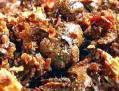
Propolis has a large variety of
colors and odours; its composition is different (after the trees from
which it was collected (not that bees prefer poplar buds); it contains
flavonoids and fenolic acids, wax and fatty acids, volatile oils, pollen
and traces of minerals.
|
|
Properties of propolis:
Propolis
is a natural antibiotic substance, used for this antibiotic properties even
in the beehive. It has an anti-microbian action against a lot of bacteria, viruses,
parasites and fungi (Staphylococcus aureus, Streptococcus sp., Escherichia
coli, Pseudomonas aeruginosa, Proteus vulgaris, Klebsiella pneumoniae, Salmonella
sp., Shigella sp., Mycobacterium tuberculosis -Koch bacillus, Helicobacter
pylori, Candida albicans, Giardia lamblia, Trichomonas vaginalis, Herpes simplex
Virus, Influenza Virus).
It is also a good
anti-oxidant (anti-tumor, anti-cancer), antispastic, anaesthesic; it protects
against the radiations.
It is also an excellent
antiinflammatory, cicatrisant, liver protector (it protects the liver against
the bad effects of the alcohol), immune and biostimulator, tonic of the capilaries
and regenerator of the tissues.
There is a remarkable
fact that propolis, due of its great variety of composition, is keeping unaltered
its antibiotic capacity (by contrary, the synthetic antibiotics become inefficient
in time, because bacterias develop resistance against them).
Use of propolis:
For internal use:
- respiratory infections (bronchitis, tracheitis, viral infections), otitis,
sinusitis, rinitis, tuberculosis
- digestive and hepatic diseases (gastritis, gastric ulcer, chronic colecistitis,
chronic hepatitis, cirrhosis, ulcerative colitis, digestive spasms)
- intestinal parasitoses
- urinary infections, prostatitis, tumors of the bladder
- painful diabetic neuropathy
- stress, migrena
- atheroscleroses
For external use:
- mouth and pharynx infections (stomatitis, gingivitis, pharingitis, amigdalitis,
dental abscesses, parodontitis, dental cavities)
- infections of the ear, nose and throat (rinitis, otitis, sinusitis, otomicosis)
- skin infections (infectious eczema, burns, wounds, varicose ulcer, fungal
infections of the hair, tuberculosis of the skin, acne, furunculosis)
- oftalmological diseases (blefaritis, conjunctivitis, scleritis, wounds)
- hemorrhoids, proctitis
- prostatitis, orhitis, epididimitis
- metroanexitis, cervicitis, menopausal distrophia
- before and after radiotherapy
- arthritis, arthrosis
Propolis has also
a lot of cosmetic uses, due to its properties
(antiseptic, antiacne, antiinflammatory, cicatrisant, anaesthesic, antioxidant,
antidandruff, protector against ultraviolet radiations and preservant). It is
used for the preparation of some sprays, shampoons, antiacneic lotions, mouth
waters, tooth pastes, nutritive ointments.
Not
to be taken in case of: allergy at propolis.
Products
with propolis:
In the present
time, in the pharmacies and natural products shops we can find out a lot of
products with propolis:
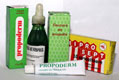
- propolis tincture - it is an alcoholic extract, usually containing 30% propolis;
it is for internal and external use
- propolis ointment (Propoderm)
- protection cream (Melrosin-prop), massage cream (Melrosin-confort - it contains
also bee venom)
- propolis suppositories (Miprosept) - they can be used also as ovules
- propolis comprimates (Proposept)
- propolis spray 10%
- honey with propolis
- the Meltonic products - they are nutritive supplements with tonic effect (general
or specific on certain organs and tissues); there are 10 complex formulas, based
on polyfloral honey, propolis extract, other bee products and extracts from
medicinal plants (there is: respiratory tonic, renal, hepatic, gastric, cardiovascular,
nervous tonic etc.)
- raw propolis, which can be used as a disinfectant and anaesthesic of the mouth
cavity - the dose is 1 g 3 times a day
- nose drops with propolis (Propoheliant)
- eye drops (for eye diseases)
- antiacneic lotion (Acneol-prop)
- mouth water (Floral)
You may choose from this products the most adequate for your health problems.
Attention! Propolis tincture is not soluble
with water, so it will be taken in a teaspoonfull of honey or on a small piece
of bread (letr the alcohol to evaporate and then you may take it).
Recipe for preparing the propolis tincture in our house: put the propolis in
a bottle (powdered if possible, to increase the contact surface with the alcohol),
then add 70-80° aethylic alcohol, respecting the proportion of 1 part propolis
to 3 parts alcohol (example: at 3 parts=30 g propolis, add 10 parts=100 g aethylic
alcohol). Let it in a dry, dark place for 7-14 days.
Then make
a primary and then a second filtration, with a filter paper. The liquid has
to be clair, witout particles, brown or reddich-colored. The tincture will be
kept in clean bottles, dark-colored, in a dark place.
If you put
some drops of tincture on a plate and let the alcohol to evaporate, you will
obtain the propolis paste, which can be mixed with other ingredients for cosmetic
use.
You may
also prepare in your house an oily extract of propolis, from 10 g of propolis
mixed with 200 g olive oil or 100 g butter. Melt it on a vapour bath for 10
minutes, at 50° C, mixing continuously. Then filter it and keep it in a
dark and cold place.
Clinical studies:
Propolis heals genital herpes faster than Acyclovir.
Vynograd N, Vynograd I, Sosnowski Z. A comparative multi-centre study of the
efficacy of propolis, acyclovir and placebo in the treatment of genital herpes
(HSV). Phytomedicine 2000; 7(1): 1-6.